


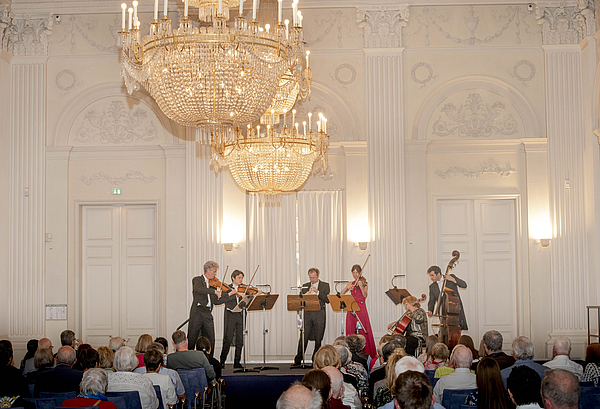
Master concert in Max-Joseph Hall with candlelight
Mozart: The Magic Flute – Overture
Mozart: A Little Night Music (Eine kleine Nachtmusik)
Strauss (son): Die Fledermaus – Overture
Strauss (son): The Hunt – Polka (Jagd-Polka)
Strauss (son): The Blue Danube – Waltz (An der schönen blauen Donau)
Strauss (son): “Tritsch-Tratsch” Polka, “Pizzicato” Polka & other Fast Polka
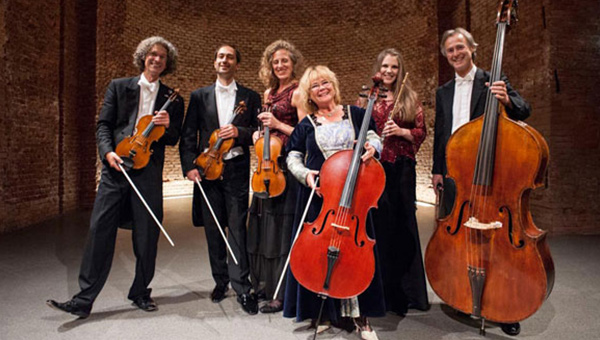
Residenz-Solisten
Johann Strauss – A Homage to the Mozart He Admired
Although Johann Strauss’s father himself was a famous composer, he was determined that his son should not become a musician. Instead, he sent the young Johann to the Polytechnic Institute so that he could pursue a respectable career as a bank clerk.
The plan did not succeed. Secretly, “Schani,” as Johann was called in the family, practiced the violin with the support of his mother. When his father once caught him playing music against his wishes, he reportedly even punished him physically. Yet rather than discouraging the boy, the incident only strengthened Johann’s determination to follow his own path. And that path clearly led toward music: according to family stories, he improvised his first waltz at the age of six.
Strauss often referred to Mozart as the “God of music,” emphasizing that Mozart’s clarity and melodic richness were, in his view, unsurpassed.
The musical parallels between Johann Strauss and Mozart can be heard especially in the lightness of their melodic writing, the clarity of formal structure, and the ambition to elevate entertainment music to a true concert level.
Strauss collected Mozart’s scores—not merely as collector’s items but as objects of study. Among them were The Marriage of Figaro, Don Giovanni, and The Magic Flute. His brother Eduard later recalled that Johann often spent long nights studying Mozart’s scores in order to uncover “the secret of Mozartian clarity.” He even left small handwritten notes and cross-references to Mozartian themes in his own manuscripts.
In his stage works in particular, such as Die Fledermaus, Strauss was inspired by the dramatic structure of Mozart’s Figaro. The way ensemble scenes are constructed and the manner in which characters are shaped through musical motifs reflect Mozart’s lasting influence.
The best things come in small packages: With wonderful stucco works and crystal, chandeliers equipped Max's Joseph hall is for many a small pearl in the residence and forms the perfect frame for classical concerts. Just chamber music friends estimate the intimate character of the space.
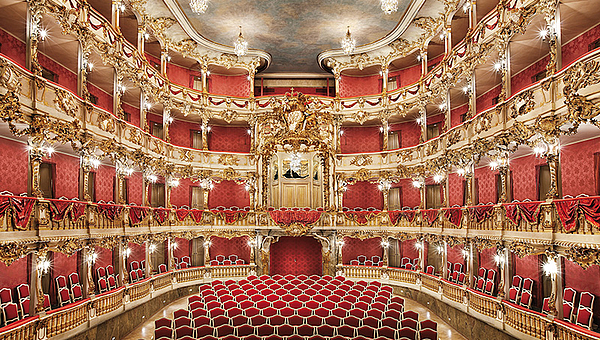
Festive Concert in the Cuvillés-Theatre
Mozart: Piano Concerto in B-flat Major, K. 595
Chopin: Polonaise
Beethoven: Symphony No. 1 in C Major
Grieg: Peer Gynt – Suite
Misora Ozaki - Piano & Residenz-Solisten
Wolfgang Amadeus Mozart completed his final piano concerto—the Piano Concerto in B-flat Major, K. 595—in Vienna in January 1791. The music radiates lightness, serenity, and quiet elegance. At the premiere, Mozart himself sat at the fortepiano; it would be his last public appearance as a pianist. In the finale, a simple, almost song-like melody appears that Mozart later used in his song “Sehnsucht nach dem Frühling” (“Longing for Spring”), with the well-known opening words: “Komm, lieber Mai …” (“Come, dear May…”). There is a special magic in this music—a gentle farewell and at the same time a hopeful anticipation of renewal.
With his Symphony No. 1 in C Major, Ludwig van Beethoven brings fresh energy and bold colors into the concert hall. Even in this early work, the unmistakable spirit of the young composer becomes evident: elegant melodic lines combine with rhythmic vitality and surprising harmonic turns. The symphony sparkles with vitality and already hints at the creative power that would soon make Beethoven one of the greatest symphonists in the history of music.
A few decades later, Frédéric Chopin sits at a piano in a Parisian salon. Under his hands, the polonaise—once a courtly Polish dance—is transformed into a virtuosic and heroic concert piece. The famous Polonaise in A-flat Major, Op. 53 in particular unfolds monumental energy: powerful bass lines, brilliant chords, and a proud, driving rhythm. Contemporary accounts even suggest that Chopin, while composing, imagined armored riders before his eyes—an image that vividly reflects the heroic aura of this music.
The colorful conclusion of the evening is music from Edvard Grieg’s score to Peer Gynt, written for Henrik Ibsen’s famous play. From this work come two of the most beloved soundscapes in the Romantic orchestral repertoire: the lyrical “Morning Mood,” in which the sunrise unfolds in delicate woodwind lines, and the mysterious “In the Hall of the Mountain King,” whose music grows from a quiet motif into a thrilling orchestral whirlwind.
Thus, in the magnificent Cuvilliés Theatre, a musical arc unfolds—from classical elegance through Romantic virtuosity to the colorful imagination of Nordic sound. The result is a festive concert evening full of brilliance, emotion, and musical discovery.
Due to limited places, wheelcair seats can only booked through +49 89 2897 5597 manually.
Master Concert in the Max-Joseph Hall with candlelight
Mozart: Bassoon Concerto in B-flat Major, K. 191
Haydn: Symphony No. 73 in D Major “La Chasse”
Strauss II: Die Fledermaus – Overture
Strauss II: Voices of Spring – Waltz (Frühlingsstimmen)
Strauss II: The Blue Danube – Waltz (An der schönen blauen Donau)
Strauss II: “Tritsch-Tratsch” Polka, “Pizzicato” Polka & other Polkas
Kaspar Reh - Fagott & Residenz-Solisten
Vienna and Johann Strauss – An Evening of Viennese Waltz Magic
Step into the elegant world of old Vienna: in the magnificent Max-Joseph-Saal of the Munich Residenz, experience an evening of charm, joie de vivre and musical splendour.
As the royal chandeliers glow in the warm candlelight, the magnificent stucco of the historic hall shimmers and the first notes begin to sound, an atmosphere of truly enchanting elegance unfolds. For one evening, time seems to stand still – and Vienna, with all its unmistakable charm, comes vividly to life.
Mozart’s Bassoon Concerto opens the evening with classical elegance and sparkling virtuosity. It is followed by Haydn’s spirited Symphony “La chasse”, filled with hunting calls, rhythmic energy and delightful musical wit.
Then the stage belongs to the “Waltz King”, Johann Strauss: the sparkling “Die Fledermaus” Overture transports you straight into the glamorous world of Viennese operetta. With “Voices of Spring”, spring itself seems to arrive in a swirl of graceful melodies and lilting Viennese waltz rhythms.
And with “The Blue Danube”, Vienna is suddenly closer than ever: the world’s most famous waltz unfolds its incomparable elegance, conjuring images of imperial Vienna and the glittering social life of the Danube metropolis.
The evening concludes in exuberant Viennese style with “Tritsch-Tratsch” Polka, “Pizzicato Polka” and further spirited quick polkas – sparkling, virtuosic and infused with the playful wit that makes Johann Strauss’s music so irresistible.
An Evening in the Spirit of Vienna
Beneath glittering royal chandeliers and in the glow of candlelight, this concert becomes a truly special social occasion: festive classical music, Viennese joie de vivre and the magnificent atmosphere of the Munich Residenz come together in an evening of elegance, charm and esprit.
Let yourself be enchanted by Mozart, Haydn and the Waltz King Johann Strauss – and experience Vienna for an evening in the royal splendour of the Max-Joseph-Saal.
Festive concert in the All-Saint-Court church
Mozart: Requiem
Mozart: Ouvertüre aus “Don Giovanni”
Mozart: Symphonie Nr. 38 “Prager”
Residenz-Solisten
Wolfgang Amadeus Mozart: Requiem in D Minor (K. 626) – Between Genius, Madness, and a Mysterious Commission
Mozart’s Requiem is his final work—and one of music history’s greatest mysteries. Few compositions are so entwined with legend as this Mass for the Dead, on which Mozart worked until his final hours in December 1791.
The “Gray Messenger” and a Dark Premonition
The story of its creation reads like a detective tale. One day, a mysterious, darkly dressed messenger arrives at Mozart’s door and anonymously commissions a Requiem. At the time, Mozart is already in frail health, and the secretive request begins to preoccupy him. He becomes obsessed with the idea that the messenger is a harbinger from the beyond, bringing news of his own death. “I am writing my own funeral song,” he is said to have remarked.
In reality, the enigmatic commissioner was Count Walsegg-Stuppach’s steward. The eccentric count often had works composed to pass off later as his own. He intended to acquire the Requiem under the same pretense.
An Unfinished Legacy
Mozart dies before completing the score. The Lacrimosa breaks off mid-composition. What he leaves behind is a fragment: the opening sections are fully orchestrated, but many later movements exist only as sketches or vocal lines.
Mozart’s widow, Constanze, now faced a dilemma: to secure the promised fee, the work had to be completed. She commissioned Mozart’s student Franz Xaver Süssmayr, who worked closely with Mozart’s sketches and even copied portions of his handwriting. The additions were so convincing that the commissioner accepted them as part of the final work.
A Sound World of Eternity
Musically, the Requiem unfolds a dark, solemn soundscape. In the dramatic key of D minor, it becomes a work of extraordinary beauty and intensity—a musical threshold between human fear, judgment, and hope for redemption.
Overture to Don Giovanni
Mozart’s overture to Don Giovanni also begins in the ominous key of D minor. With massive, almost Dantean chords, the music immediately fills the space—an ominous prelude to the later appearance of the “Stone Guest.” This is followed by a restless, feverish Allegro, brimming with the opera’s demonic energy.The overture condenses all the elements that define the work: tragedy and comedy, menace and vitality. Mozart composed it under immense time pressure; tradition has it that he completed the score the night before the Prague premiere in 1787. During the night, Constanze kept him awake with stories and punch, and by morning the copyists had the freshly written parts. That evening, the orchestra had to play the complex piece almost sight-read.
A typical Mozart moment: genius racing against time.
Master Concert in the Max-Joseph Hall with candlelight
Vivaldi: „Die vier Jahreszeiten“ – gesamt
Mozart: Eine kleine Nachtmusik
Corelli: Weihnachtskonzert
Händel: Concerto grosso
Pachelbel: Kanon
Marcelino Rojas - Violine & Residenz-Solisten
A Musical Winter Evening Filled with Splendour
Vivaldi’s vivid “Four Seasons”, Mozart’s effortless elegance and the festive sounds of Corelli, Handel and Pachelbel come together in a concert evening filled with virtuosity, warmth and the magic of the Christmas season.
In the magnificent Max-Joseph-Saal, beneath glittering royal chandeliers and surrounded by candlelight, this becomes an experience of rare beauty: great music in an exquisite setting where the magic of Christmas seems to glow with a life of its own.
Vivaldi: “The Four Seasons”
Few works bring nature to life with such immediacy and vivid colour as Vivaldi’s “The Four Seasons.” Across the four violin concertos unfolds a fascinating panorama of birdsong and spring breezes, summer heat and approaching thunderstorms, the joy of the harvest and the quiet stillness of winter.
Virtuosic passages, radiant colours and unforgettable melodies make this masterpiece an ever-fresh experience – alive with movement, poetry and the unmistakable spirit of Italy.
Mozart: Eine kleine Nachtmusik
With its graceful elegance and crystalline clarity, Mozart’s “Eine kleine Nachtmusik” is one of those rare works that enchants from the very first note. Light-footed, charming and seemingly effortless in its perfection, it creates an atmosphere of refined sociability and classical sophistication.
A timeless Mozart moment – full of lightness, charm and joie de vivre.
Corelli: Christmas Concerto
With Corelli’s Christmas Concerto, the special atmosphere of Advent takes centre stage. Warm string sonorities, delicate melodic lines and festive elegance combine to create music of intimate beauty.
Traditionally associated with the Christmas season, this beloved work evokes the quiet anticipation and warmth that make Advent so enchanting – festive, graceful and deeply atmospheric.
Handel: Concerto Grosso
Handel’s Concerto Grosso embodies the splendour of the Baroque at its finest. In the lively interplay between soloists and ensemble, a captivating musical dialogue unfolds, filled with virtuosity and festive brilliance.
Elegant melodic lines, powerful accents and Handel’s unmistakable grandeur give the work a majestic presence – music that reveals its full magnificence in a setting of such splendour.
Pachelbel: Canon
Pachelbel’s Canon touches the heart through its simplicity and timeless beauty. Above its gently unfolding harmonic foundation, the melody gradually blossoms, building layer by layer into a warm and almost weightless tapestry of sound.
Timelessly elegant and deeply moving, the Canon offers a moment of quiet reflection – bringing the concert evening to a serene and beautiful close.
Festive concert
Fünf Klavierkonzerte
J.S.Bach: Klavierkonzert Nr.1 D-Moll BWV 1052
J.S.Bach: Klavierkonzert Nr.2 E-Dur BWV 1053
J.S.Bach: Klavierkonzert Nr.3 D-Dur BWV 1054
J.S.Bach: Klavierkonzert Nr.4 A-Dur BWV 1055
J.S.Bach: Klavierkonzert Nr.5 F-Moll BWV 1056
Collins Tanujaya, Dongqi Zhang, Naoe Sasaki, Carles Diaz Morros, Rezi Marshania - Klavier & Residenz-Solisten
On this festive occasion, the All Saints’ Court Church Allerheiligen Hofkirche glows in the warm light of candles, opening its venerable spaces for an extraordinary musical experience: the five great Bach piano concertos, masterfully performed by Collins Tanujaya, Dongqi Zhang, Naoe Sasaki, Carles Díaz Morros, and Rezi Marshania, accompanied by the Residenz-Solisten.
Bach’s Piano Concerto No. 1 in D minor, BWV 1052 is considered one of the most powerful and technically demanding works of Baroque music. Originally likely conceived as a violin concerto, it captivates with dramatic energy and a virtuosity that feels strikingly modern.
In contrast, the Piano Concerto No. 2 in E major, BWV 1053 is brighter, more pastoral, and relaxed. It is a prime example of Bach’s masterful parody technique, featuring luminous, dance-like character, buoyant rhythms, and elegant melodies that refresh the senses.
Majestic and radiant, Piano Concerto No. 3 in D major, BWV 1054 is a transcription of Bach’s famous Violin Concerto in E major (BWV 1042). Bach likely created this version between 1738 and 1739 for the concerts of the Collegium Musicum in Leipzig, where he himself performed the solo part on the harpsichord. Its splendid harmonies and dynamic contrasts fill the hall with energy.
The elegant Piano Concerto No. 4 in A major, BWV 1055 is one of Bach’s most radiant and lively works for keyboard. It impresses with subtle counterpoint and sparkling piano passages that artfully complement the strings.
The crowning conclusion is Piano Concerto No. 5 in F minor, BWV 1056, whose passionate drama and poetic delicacy linger long after the final note.
In the intimate atmosphere of candlelight, music, light, and historic architecture merge into an unforgettable experience. Every note becomes a treasure, every phrase an invitation to immerse oneself fully in Bach’s world of sound.
Master Concert in the Max-Joseph Hall with candlelight
Mozart: Flute Concerto in G major
Cimarosa: Concerto for Flute and Oboe
Salieri: Sinfonia Veneziana – Allegro
J. Strauss: "Die Fledermaus" Overture
J. Strauss: "Auf der Jagd" (The Hunt) – Quick Polka
J. Strauss: "Tritsch-Tratsch", "Pizzicato" & other quick polkas
Michael Kofler - Flute, Giovanni De Angeli – Oboe & Residenz-Solisten
From Venice to Vienna
Antonio Salieri’s "Sinfonia Veneziana" provides a sparkling opening to our program. Contrary to the dark myths popularized by film, this Allegro reveals exactly why Salieri was the darling of the Viennese court: his music breathes the vibrant spirit of Venice and sets the stage with pure Italian joie de vivre. That woodwinds experienced a golden era during this period is then proven by Domenico Cimarosa. In his Concerto for Flute and Oboe, a playful dialogue unfolds between the two solo instruments, sounding much like a scene from a comic opera—a musical conversation between equals.
Wolfgang Amadeus Mozart proves that one can create true masterpieces for an instrument even when "at odds" with it. Despite his alleged dislike of the flute, his Flute Concerto in G major is a work of such brilliance and grace that it has become an undisputed staple of the repertoire. it concludes the classical portion of the evening with that divine lightness unique to Mozart.
After the intermission, we move from courtly ceremony to the ballroom to celebrate the "Waltz King." The overture to "Die Fledermaus" transports us into the golden age of Viennese operetta—a work Johann Strauss composed in a feverish burst of creativity lasting only 42 days. Things then turn playful: while the "Pizzicato Polka" creates an almost magical, feather-light atmosphere through the delicate plucking of strings, the "Tritsch-Tratsch Polka" mirrors the rapid-fire gossip of Viennese society. Strauss composed it as a humorous response to the rumors the tabloid press of the time spread about his turbulent private life.
The crowning finale is Austria's unofficial anthem: "The Blue Danube." It is hard to believe that this global hit was nearly a failure at its premiere as a choral waltz. It was only as a purely instrumental version that it began its triumphal march around the globe, becoming the ultimate symbol of the Viennese way of life
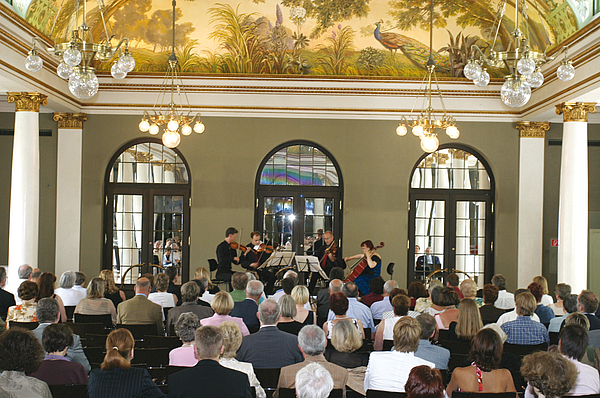
Gourmet Classic
Vivaldi: Violin Concerto „L'estro armonico”
Vivaldi: Concerto for Two Violins
Pachelbel: Canon
Mozart: “Eine kleine Nachtmusik” - Serenade
Rossini: “Figaro’s Aria”
Residenz-Solisten
Music, culinary delights, and Munich's unique lifestyle: Käfer's Gourmet Classics – a morning for all the senses, elegantly combining music and fine dining.
An extraordinary experience awaits you at Käfer's Gourmet Classics: In cooperation with Käfer delicatessen, great classical music and the finest Munich culinary culture come together for an elegant morning at the Prinzregententheater. Your visit begins in the magnificent Garden Hall of the Prinzregententheater with a stylish champagne reception.
Afterwards, the Residenz Soloists invite you to a one-hour concert featuring selected masterpieces of classical music – a musical delight in a special setting. The experience continues with a culinary treat: an exquisite lunch awaits you at Käfer's traditional Prinzipal restaurant, offering the opportunity to conclude your concert visit in a relaxed and convivial atmosphere.
