


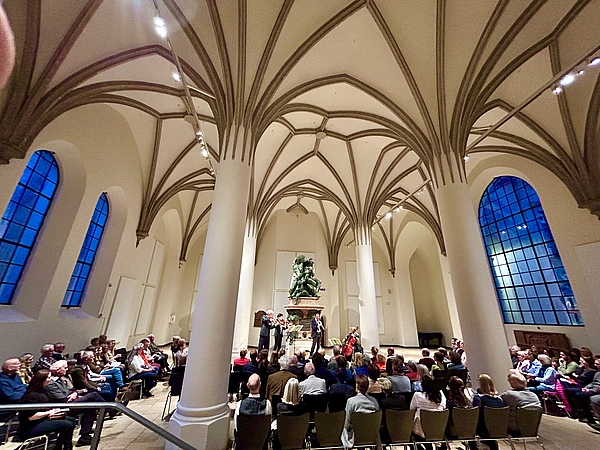
Classical music in the museum
Mozart: “A Little Night Music”
J. Strauß: “Die Fledermaus” Overture
J. Strauß: “The Blue Danube” Waltz
J. Strauß: “Tritsch-Tratsch”, “Pizzicato” & other quick polkas
Residence-Solists
Johann Strauß and his Homage to W.A.Mozart
Although his father, Johann Strauss I, was himself a famous composer and bandleader, he did not want his son to become a musician under any circumstances. Instead, he sent the young Johann Strauss II—affectionately called “Schani” within the family—to the Polytechnic Institute so that he could pursue a respectable career as a bank clerk. The plan, however, did not succeed. With the support of his mother, Johann secretly practiced the violin. When his father once caught him playing music against his wishes, he is said to have punished him severely. Rather than discouraging the boy, the incident only strengthened his determination to follow his own path. His musical talent became apparent very early: according to family stories, Johann improvised his first waltz at the age of six.
One of the greatest inspirations for the later “Waltz King” was Wolfgang Amadeus Mozart, whom Strauss often referred to reverently as the “God of Music.” He particularly admired Mozart’s clarity, melodic richness, and the seemingly effortless elegance of his compositions. These qualities can also be heard in Strauss’s own music—in the graceful flow of his melodies, the clarity of his musical forms, and his ambition to elevate dance and entertainment music to a true concert level.
Strauss collected Mozart’s scores with great enthusiasm, including operas such as Le nozze di Figaro, Don Giovanni, and Die Zauberflöte. His brother Eduard Strauss later recalled that Johann would often sit late into the night studying these scores, trying—as he put it—to discover “the secret of Mozartian clarity.” In his own manuscripts he sometimes left small handwritten notes or cross-references to Mozartian themes.
Mozart’s influence is especially evident in Strauss’s stage works. In his famous operetta Die Fledermaus, for example, Strauss drew inspiration from the dramatic structure of Mozart’s Le nozze di Figaro. The way ensemble scenes are constructed and characters are musically portrayed reflects Mozart’s operatic artistry. Thus, Johann Strauss was not only the master of the Viennese waltz but also a composer deeply connected to the great tradition of classical music.
Classical music in the museum
Masterpieces of the Baroque
Featuring works by Vivaldi, Bach, Albinoni, Marcello, Telemann and others – performed on period instruments.
Residenz Soloists
Masterpieces of the Baroque
This program is dedicated to the fascinating soundscape of the Baroque era, presenting works by prominent composers of the 17th and early 18th centuries—performed on period instruments that bring the authentic sound of this epoch back to life.
At the heart of the program is the music of Antonio Vivaldi, whose concertos are characterized by virtuosity, rhythmic energy, and tonal color. Through his works, he decisively advanced the solo concerto and impressively demonstrated the expressive possibilities of the violin in dialogue with the orchestra.
Francesco Maria Veracini was also among the great virtuosos of his time. His compositions are technically demanding and distinguished by bold harmonies and a particularly expressive violin language.
In contrast, the music of Tomaso Albinoni stands for melodic elegance and tonal clarity. His works reflect the lyrical side of the Venetian Baroque and are renowned for their graceful melodies.
With Benedetto Marcello, we encounter a composer who combines musical sophistication with clear formal structures. His works showcase the cultural and artistic diversity of the Venetian musical tradition.
The program is rounded off with music by Georg Philipp Telemann, one of the most prolific and versatile composers of the Baroque. His works unite influences from various European styles and are characterized by great inventiveness and musical vitality.
Performed on period instruments, this concert offers an impressive insight into the soundworld of the Baroque, making the elegance, virtuosity, and expressive power of this era directly tangible.
Residence-Soloists
Classical music in the museum
Vivaldi: The Four Seasons – “Autumn” & “Winter”
Grieg: Peer Gynt – Suite
Pachelbel: Canon
Tchaikovsky: Highlights from The Nutcracker & Swan Lake
Residence-Soloists
Concert Program – From Baroque to Romantic
The Four Seasons – Autumn & Winter – Antonio Vivaldi
Vivaldi’s vivid violin concertos depict the colors and moods of the seasons. In Autumn and Winter, the composer contrasts festive dances, rustic celebrations, and the chill of icy landscapes with virtuosic passages and dynamic orchestral interplay.
Peer Gynt Suite – Edvard Grieg
Grieg’s suite from Henrik Ibsen’s play captures Norwegian landscapes, folk-inspired melodies, and dramatic storytelling. From the lyrical Morning Mood to the lively In the Hall of the Mountain King, the music blends poetic lyricism with rhythmic vitality.
Canon in D – Johann Pachelbel
One of the most famous Baroque pieces, Pachelbel’s canon features three violins in imitative dialogue over a repeating bass line. Its serene harmonies and elegant structure make it a timeless favorite.
Highlights from The Nutcracker & Swan Lake – Pyotr Ilyich Tchaikovsky
Tchaikovsky’s ballet music brings magical storytelling to life, from the sparkling Dance of the Sugar Plum Fairy to the dramatic and lyrical passages of Swan Lake. The orchestration combines brilliant color, rhythmic drive, and memorable melodies, making these works enduring classics of the Romantic repertoire.
Classical music in the museum
Masterpieces of piano literature by Chopin and others.
Pianist of the Residence-Soloists
The concert series "Classical music in the museum" combines an 60 minutes concert by the Residence Soloists and the museum entrance.
Classical music in the museum
Baroque masterpieces featuring works by Vivaldi, Bach, Albinoni, Marcello, Telemann, and others, performed on period instruments.
Residence-Soloists
The concert series "Classical music in the museum" combines an 60 minutes concert by the Residence Soloists and the museum entrance.
Classical music in the museum
Mozart: "Eine kleine Nachtmusik"
J. Strauss: "Die Fledermaus" – Overture
J. Strauss: "The Blue Danube" – Waltz
J. Strauss: "Tritsch-Tratsch", "Pizzicato" & other fast polkas
Residence-Soloists
The concert series "Classical music in the museum" combines an 60 minutes concert by the Residence Soloists and the museum entrance.
Classical music in the museum
Vivaldi: "The Four Seasons" – "Winter"
Vivaldi: Violin Concertos "La Stravaganza" & "L'estro armonico"
Mozart: Serenade "Eine kleine Nachtmusik"
Rossini: Figaro's Aria
Residenz Solisten
The concert series "Classical music in the museum" combines an 60 minutes concert by the Residence Soloists and the museum entrance.
Classical music in the museum
Marcello: Oboenkonzert
Vivaldi: „Die vier Jahreszeiten“ – „Winter“
Albinoni: Oboenkonzert D-Moll
Vivaldi: Violinkonzert „La stravaganza“
Vivaldi: Oboenkonzert
Rossini: Arie des Figaro
Giovanni De Angeli - Oboe & Residenz Solisten
The concert series "Classical music in the museum" combines an 60 minutes concert by the Residence Soloists and the museum entrance.
Classical music in the museum
Vivaldi: Harfenkonzert
Vivaldi: Flötenkonzert „La tempesta di mare“
Mozart: Arien aus „Die Zauberflöte“ & "Die Hochzeit des Figaro“
Haydn: Konzert für Flöte und Harfe
Smetana: Die Moldau
Bizet: Carmen-Fantasy
J.Schöllhorn - Flöte, E.Jaulmes - Harfe & Residenz Solisten
The concert series "Classical music in the museum" combines an 60 minutes concert by the Residence Soloists and the museum entrance.
Classical music in the museum
Masterpieces of piano literature by Chopin and others
Meisterpianist der Residenz-Solisten
The concert series "Classical music in the museum" combines an 60 minutes concert by the Residence Soloists and the museum entrance.
