


Master Concert
J.S. Bach: Brandenburg Concerto No. 2
J.S. Bach: Brandenburg Concerto No. 4
J.S. Bach: Brandenburg Concerto No. 5
J.S. Bach: Double Concerto for Oboe and Violin
Händel: "Water Music"
Michael Kofler – Flute (MPhil), Rodrigo Belío - Cembalo, Gabriele Cassone – Trumpet, Giovanni De Angeli – Oboe, Karsten Gebhardt – Violin, Marcelino Rojas – Violin & Residence Soloists (Residenz-Solisten)
Baroque Brilliance: From the Court to the River
Baroque music often owes its most dazzling moments to practical coincidences or courtly obligations, as seen in Johann Sebastian Bach’s famous Brandenburg Concertos. When Bach sent the scores to the Margrave of Brandenburg in 1721, it was essentially a musical job application. The Concerto No. 2 stands out for its almost acrobatic trumpet part. It is said that Bach wrote it specifically for a virtuoso in Köthen; in Brandenburg, however, the scores likely gathered dust in the archives, as no musician in the local chapel could master those dizzying heights.
In Concerto No. 4, Bach’s fondness for sonic experimentation shines through as he combines a solo violin with two "echo flutes," giving the work a bright, pastoral character. Bach’s pragmatic side is evident in Concerto No. 5, which is considered the birth of the modern keyboard concerto. He moved the harpsichord—previously a background accompaniment—into the spotlight. Anecdote has it that he composed this work as a "test drive" for a precious new harpsichord he had just acquired from Berlin for his Prince; the monumental solo cadenza in the first movement was quite simply intended to impress the audience (and the buyer).
Bach’s Double Concerto for Oboe and Violin also has a storied past. Today, the work officially survives only in a version for two pianos. However, musicologists reconstructed the original version because the flowing, almost sighing melodies of the slow movement were so clearly crafted for the "breathing" oboe and the singing violin. The famous Bach scholar Albert Schweitzer even believed that only in this instrumentation does the true soul of the piece emerge.
In stark contrast to Bach’s more intimate court music, George Frideric Handel’s "Water Music" was designed for grand outdoor spectacle. In July 1717, Handel accompanied King George I of England on a nocturnal boat trip along the Thames. The King was so enchanted by the festive splendor of the music that he forced the musicians to play the entire suite three times in a row. For the orchestra, seated on a swaying boat alongside the royal barge, this meant hours of continuous performance without a break—a feat of endurance that transformed the Thames into a massive concert stage until the early hours of the morning.
Master New Years Eve Concert
Mozart: Piano Concerto in E-flat major No. 14, K. 449
Gershwin: Rhapsody in Blue
Strauss: Die Fledermaus Overture
Strauss: The Blue Danube Waltz
Strauss: "Tritsch-Trasch" - "Pizzicato" & other fast polkas
Frank Fan Ming Ling – Klavier & Residence-Soloists
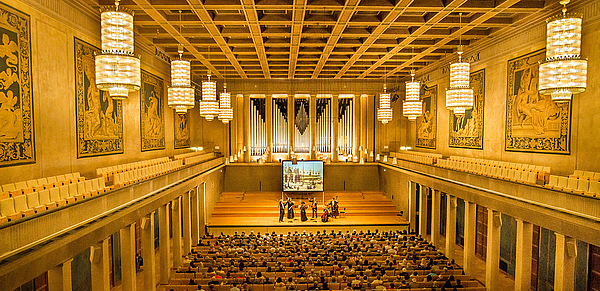
The Hercules Hall was originally the throne room of Louis I and was built as a concert hall after its reconstruction. It served as a replacement for Klenze’s Odeon, which was also destroyed. Until the opening of the Philharmonie am Gasteig, it was the most important concert hall in Munich. Its name comes from the tapestries depicting the Hercules saga commissioned by Duke Albrecht V in 1556.
Master Concert
Vivaldi: "The Four Seasons" – Excerpts
Beethoven: Symphony No. 9 in D minor
Residence-Soloists
The Hercules Hall was originally the throne room of Louis I and was built as a concert hall after its reconstruction. It served as a replacement for Klenze’s Odeon, which was also destroyed. Until the opening of the Philharmonie am Gasteig, it was the most important concert hall in Munich. Its name comes from the tapestries depicting the Hercules saga commissioned by Duke Albrecht V in 1556.
