


Festive concert
Fünf Klavierkonzerte
J.S.Bach: Klavierkonzert Nr.1 D-Moll BWV 1052
J.S.Bach: Klavierkonzert Nr.2 E-Dur BWV 1053
J.S.Bach: Klavierkonzert Nr.3 D-Dur BWV 1054
J.S.Bach: Klavierkonzert Nr.4 A-Dur BWV 1055
J.S.Bach: Klavierkonzert Nr.5 F-Moll BWV 1056
Collins Tanujaya, Dongqi Zhang, Naoe Sasaki, Carles Diaz Morros, Rezi Marshania - Klavier & Residenz-Solisten
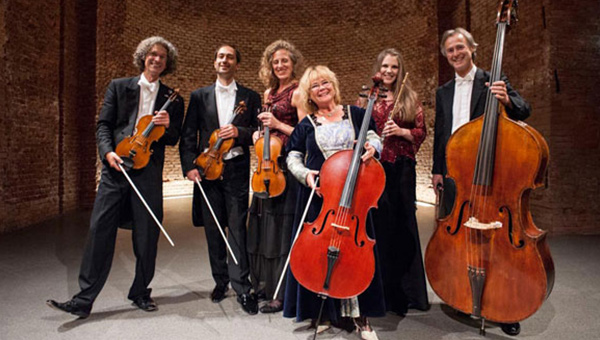
On this festive occasion, the All Saints’ Court Church Allerheiligen Hofkirche glows in the warm light of candles, opening its venerable spaces for an extraordinary musical experience: the five great Bach piano concertos, masterfully performed by Collins Tanujaya, Dongqi Zhang, Naoe Sasaki, Carles Díaz Morros, and Rezi Marshania, accompanied by the Residenz-Solisten.
Bach’s Piano Concerto No. 1 in D minor, BWV 1052 is considered one of the most powerful and technically demanding works of Baroque music. Originally likely conceived as a violin concerto, it captivates with dramatic energy and a virtuosity that feels strikingly modern.
In contrast, the Piano Concerto No. 2 in E major, BWV 1053 is brighter, more pastoral, and relaxed. It is a prime example of Bach’s masterful parody technique, featuring luminous, dance-like character, buoyant rhythms, and elegant melodies that refresh the senses.
Majestic and radiant, Piano Concerto No. 3 in D major, BWV 1054 is a transcription of Bach’s famous Violin Concerto in E major (BWV 1042). Bach likely created this version between 1738 and 1739 for the concerts of the Collegium Musicum in Leipzig, where he himself performed the solo part on the harpsichord. Its splendid harmonies and dynamic contrasts fill the hall with energy.
The elegant Piano Concerto No. 4 in A major, BWV 1055 is one of Bach’s most radiant and lively works for keyboard. It impresses with subtle counterpoint and sparkling piano passages that artfully complement the strings.
The crowning conclusion is Piano Concerto No. 5 in F minor, BWV 1056, whose passionate drama and poetic delicacy linger long after the final note.
In the intimate atmosphere of candlelight, music, light, and historic architecture merge into an unforgettable experience. Every note becomes a treasure, every phrase an invitation to immerse oneself fully in Bach’s world of sound.
Master Concert
J.S. Bach: Brandenburg Concerto No. 2
J.S. Bach: Brandenburg Concerto No. 4
J.S. Bach: Brandenburg Concerto No. 5
J.S. Bach: Double Concerto for Oboe and Violin
Händel: "Water Music"
Michael Kofler – Flute (MPhil), Gabriele Cassone – Trumpet, Giovanni De Angeli – Oboe, Karsten Gebhardt – Violin, Marcelino Rojas – Violin, Tun-Han Hu – Harpsichord & Residenz Soloists (Residenz-Solisten)
Baroque Brilliance: From the Court to the River
Baroque music often owes its most dazzling moments to practical coincidences or courtly obligations, as seen in Johann Sebastian Bach’s famous Brandenburg Concertos. When Bach sent the scores to the Margrave of Brandenburg in 1721, it was essentially a musical job application. The Concerto No. 2 stands out for its almost acrobatic trumpet part. It is said that Bach wrote it specifically for a virtuoso in Köthen; in Brandenburg, however, the scores likely gathered dust in the archives, as no musician in the local chapel could master those dizzying heights.
In Concerto No. 4, Bach’s fondness for sonic experimentation shines through as he combines a solo violin with two "echo flutes," giving the work a bright, pastoral character. Bach’s pragmatic side is evident in Concerto No. 5, which is considered the birth of the modern keyboard concerto. He moved the harpsichord—previously a background accompaniment—into the spotlight. Anecdote has it that he composed this work as a "test drive" for a precious new harpsichord he had just acquired from Berlin for his Prince; the monumental solo cadenza in the first movement was quite simply intended to impress the audience (and the buyer).
Bach’s Double Concerto for Oboe and Violin also has a storied past. Today, the work officially survives only in a version for two pianos. However, musicologists reconstructed the original version because the flowing, almost sighing melodies of the slow movement were so clearly crafted for the "breathing" oboe and the singing violin. The famous Bach scholar Albert Schweitzer even believed that only in this instrumentation does the true soul of the piece emerge.
In stark contrast to Bach’s more intimate court music, George Frideric Handel’s "Water Music" was designed for grand outdoor spectacle. In July 1717, Handel accompanied King George I of England on a nocturnal boat trip along the Thames. The King was so enchanted by the festive splendor of the music that he forced the musicians to play the entire suite three times in a row. For the orchestra, seated on a swaying boat alongside the royal barge, this meant hours of continuous performance without a break—a feat of endurance that transformed the Thames into a massive concert stage until the early hours of the morning.
Festive Christmas Concert
J.S. Bach: Overture in B minor
J.S. Bach: Brandenburg Concerto No. 5
Vivaldi: "Winter" from "The Four Seasons"
Corelli: Christmas Concerto
Handel: Concerto grosso
Vivaldi: Flute Concerto "La Notte"
Michael Kofler - Flute MPhil, Tun-Han Hu - Cembalo & Residence-Soloists
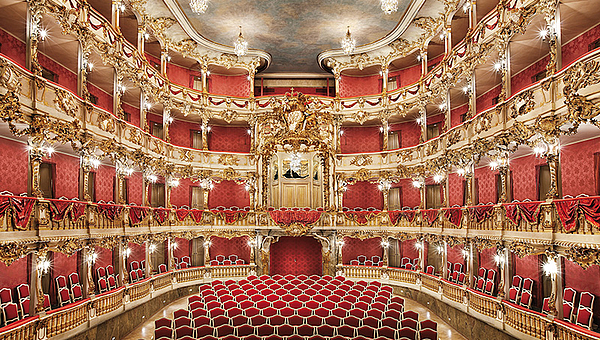
The Cuvilliés Theater is one only of the most beautiful and also one of the most important rococo theaters in Europe. In 1753, the hall, decorated entirely in royal purple and gold, with it‘s 14 boxes on 4 floors under Maximilian III. Joseph will be opened. Well-known operas such as Mozart's “Indomeneo” were premiered here. In 1806, Emperor Napoleon attended the opera “Don Giovanni” on the occasion of the inauguration of Bavaria. The Cuvilliés Theater with its “Style rocaille” is an art-historical work of art.
Experience the Residence Soloists in this unique, magnificent environment with a richness of sound that does credit to the masters of classical music and makes their performance a very special listening pleasure.
The Middle Logde is only available per phone-call under: +49 89 2897 5597.
Due to limited places, wheelcair seats can only booked through +49 89 2897 5597 manually.
Festive Christmas Concert
Vivaldi: "Winter" from "The Four Seasons"
J. S. Bach: Double Concerto for Oboe and Violin
Corelli: Christmas Concerto
Handel: Concerto Grosso
Vivaldi: Concerto for Oboe
Tchaikovsky: Highlights from "The Nutcracker" and "Swan Lake"
Tschaikowski: „Nußknacker“ und „Schwanensee“
Karsten Gebhardt - Violin, Giovanni De Angeli – Oboe, Tun-Han Hu - Cembalo & Residence-Soloists
The Cuvilliés Theater is one only of the most beautiful and also one of the most important rococo theaters in Europe. In 1753, the hall, decorated entirely in royal purple and gold, with it‘s 14 boxes on 4 floors under Maximilian III. Joseph will be opened. Well-known operas such as Mozart's “Indomeneo” were premiered here. In 1806, Emperor Napoleon attended the opera “Don Giovanni” on the occasion of the inauguration of Bavaria. The Cuvilliés Theater with its “Style rocaille” is an art-historical work of art.
Experience the Residence Soloists in this unique, magnificent environment with a richness of sound that does credit to the masters of classical music and makes their performance a very special listening pleasure.
The Middle Logde is only available per phone-call under: +49 89 2897 5597.
Due to limited places, wheelcair seats can only booked through +49 89 2897 5597 manually.
