


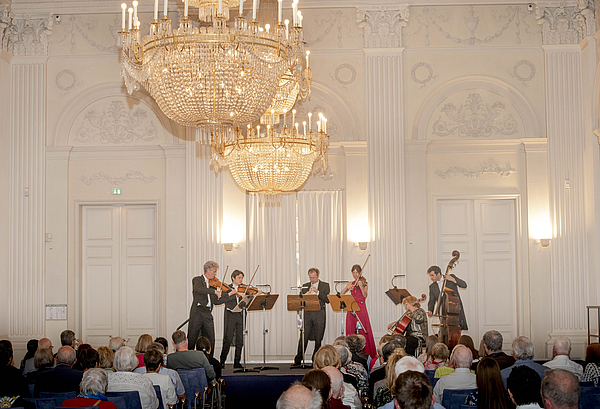
Master concert in the Max-Joseph Hall with Candlelight
Frédéric Chopin: Scherzo No. 2 in B-flat minor
Johann Sebastian Bach / Sergei Rachmaninoff: Partita No. 3
George Gershwin: 18 Songs for Piano
George Gershwin: Porgy and Bess – “Summertime”, “Bess, You Is My Woman Now”, “It Ain’t Necessarily So”
George Gershwin: 3 Preludes
Jazz Standards & Improvisation
Frank Fan Ming Ling - Klavier
From Chopin to Gershwin – When Classical Music Becomes Jazz
The modern jazz piano recital is not really a radical new beginning, but rather a fascinating continuation of the classical tradition. The clarity of Johann Sebastian Bach, the poetic lyricism of Frédéric Chopin, and the rich romantic sonorities of Sergei Rachmaninoff gradually lead toward the freedom we hear in jazz.
Rachmaninoff, often described as the “last Romantic,” deeply admired Chopin. For him, Chopin represented the ideal model: brilliant piano technique combined with profound emotional expression. In his Variations on a Theme of Chopin, Rachmaninoff allowed Chopin’s delicate melodies to shine within a new and broader sound world.
When Rachmaninoff emigrated to the United States in 1918, he encountered an entirely new musical energy: jazz. Surprisingly open to this development, he followed it with great interest. He especially admired George Gershwin, whose music brought together classical tradition, blues, and jazz. Rachmaninoff listened enthusiastically to Gershwin’s works and even attended concerts that presented this new blend of classical and jazz.
In this way, a musical line emerges: from Chopin’s poetic piano style, through Rachmaninoff’s expansive romantic sound world, to Gershwin’s “symphonic jazz.”
Within jazz itself, another element plays a central role: improvisation. A so-called jazz standard is the well-known musical theme—the shared foundation, so to speak. Musicians take this theme and invent new melodies over it in the moment. It is a little like a conversation: the theme provides the starting point, while improvisation brings the personal, spontaneous story.
Thus a bridge is formed from the classical piano tradition to the free and sparkling world of jazz.
Master concert in Max-Joseph Hall with candlelight
Mozart: The Magic Flute – Overture
Mozart: A Little Night Music (Eine kleine Nachtmusik)
Strauss (son): Die Fledermaus – Overture
Strauss (son): The Hunt – Polka (Jagd-Polka)
Strauss (son): The Blue Danube – Waltz (An der schönen blauen Donau)
Strauss (son): “Tritsch-Tratsch” Polka, “Pizzicato” Polka & other Fast Polka
Residenz-Solisten
Johann Strauss – A Homage to the Mozart He Admired
Although Johann Strauss’s father himself was a famous composer, he was determined that his son should not become a musician. Instead, he sent the young Johann to the Polytechnic Institute so that he could pursue a respectable career as a bank clerk.
The plan did not succeed. Secretly, “Schani,” as Johann was called in the family, practiced the violin with the support of his mother. When his father once caught him playing music against his wishes, he reportedly even punished him physically. Yet rather than discouraging the boy, the incident only strengthened Johann’s determination to follow his own path. And that path clearly led toward music: according to family stories, he improvised his first waltz at the age of six.
Strauss often referred to Mozart as the “God of music,” emphasizing that Mozart’s clarity and melodic richness were, in his view, unsurpassed.
The musical parallels between Johann Strauss and Mozart can be heard especially in the lightness of their melodic writing, the clarity of formal structure, and the ambition to elevate entertainment music to a true concert level.
Strauss collected Mozart’s scores—not merely as collector’s items but as objects of study. Among them were The Marriage of Figaro, Don Giovanni, and The Magic Flute. His brother Eduard later recalled that Johann often spent long nights studying Mozart’s scores in order to uncover “the secret of Mozartian clarity.” He even left small handwritten notes and cross-references to Mozartian themes in his own manuscripts.
In his stage works in particular, such as Die Fledermaus, Strauss was inspired by the dramatic structure of Mozart’s Figaro. The way ensemble scenes are constructed and the manner in which characters are shaped through musical motifs reflect Mozart’s lasting influence.
The best things come in small packages: With wonderful stucco works and crystal, chandeliers equipped Max's Joseph hall is for many a small pearl in the residence and forms the perfect frame for classical concerts. Just chamber music friends estimate the intimate character of the space.
Master Concert in the Max-Joseph Hall with candlelight
Mozart: Bassoon Concerto in B-flat Major, K. 191
Haydn: Symphony No. 73 in D Major “La Chasse”
Strauss II: Die Fledermaus – Overture
Strauss II: Voices of Spring – Waltz (Frühlingsstimmen)
Strauss II: The Blue Danube – Waltz (An der schönen blauen Donau)
Strauss II: “Tritsch-Tratsch” Polka, “Pizzicato” Polka & other Polkas
Kaspar Reh - Fagott & Residenz-Solisten
Vienna and Johann Strauss – An Evening of Viennese Waltz Magic
Step into the elegant world of old Vienna: in the magnificent Max-Joseph-Saal of the Munich Residenz, experience an evening of charm, joie de vivre and musical splendour.
As the royal chandeliers glow in the warm candlelight, the magnificent stucco of the historic hall shimmers and the first notes begin to sound, an atmosphere of truly enchanting elegance unfolds. For one evening, time seems to stand still – and Vienna, with all its unmistakable charm, comes vividly to life.
Mozart’s Bassoon Concerto opens the evening with classical elegance and sparkling virtuosity. It is followed by Haydn’s spirited Symphony “La chasse”, filled with hunting calls, rhythmic energy and delightful musical wit.
Then the stage belongs to the “Waltz King”, Johann Strauss: the sparkling “Die Fledermaus” Overture transports you straight into the glamorous world of Viennese operetta. With “Voices of Spring”, spring itself seems to arrive in a swirl of graceful melodies and lilting Viennese waltz rhythms.
And with “The Blue Danube”, Vienna is suddenly closer than ever: the world’s most famous waltz unfolds its incomparable elegance, conjuring images of imperial Vienna and the glittering social life of the Danube metropolis.
The evening concludes in exuberant Viennese style with “Tritsch-Tratsch” Polka, “Pizzicato Polka” and further spirited quick polkas – sparkling, virtuosic and infused with the playful wit that makes Johann Strauss’s music so irresistible.
An Evening in the Spirit of Vienna
Beneath glittering royal chandeliers and in the glow of candlelight, this concert becomes a truly special social occasion: festive classical music, Viennese joie de vivre and the magnificent atmosphere of the Munich Residenz come together in an evening of elegance, charm and esprit.
Let yourself be enchanted by Mozart, Haydn and the Waltz King Johann Strauss – and experience Vienna for an evening in the royal splendour of the Max-Joseph-Saal.
Master Concert in the Max-Joseph Hall with candlelight
Vivaldi: “Vier Jahreszeiten” - gesamt
Mozart: “Eine kleine Nachmusik”
Pachelbel: “Canon”
Simon Zhu - Violin & Residenz-Soloists
A Musical Winter Evening Filled with Splendour
Vivaldi’s vivid “Four Seasons”, Mozart’s effortless elegance and the festive sounds of Corelli, Handel and Pachelbel come together in a concert evening filled with virtuosity, warmth and the magic of the Christmas season.
In the magnificent Max-Joseph-Saal, beneath glittering royal chandeliers and surrounded by candlelight, this becomes an experience of rare beauty: great music in an exquisite setting where the magic of Christmas seems to glow with a life of its own.
Vivaldi: “The Four Seasons”
Few works bring nature to life with such immediacy and vivid colour as Vivaldi’s “The Four Seasons.” Across the four violin concertos unfolds a fascinating panorama of birdsong and spring breezes, summer heat and approaching thunderstorms, the joy of the harvest and the quiet stillness of winter.
Virtuosic passages, radiant colours and unforgettable melodies make this masterpiece an ever-fresh experience – alive with movement, poetry and the unmistakable spirit of Italy.
Mozart: Eine kleine Nachtmusik
With its graceful elegance and crystalline clarity, Mozart’s “Eine kleine Nachtmusik” is one of those rare works that enchants from the very first note. Light-footed, charming and seemingly effortless in its perfection, it creates an atmosphere of refined sociability and classical sophistication.
A timeless Mozart moment – full of lightness, charm and joie de vivre.
Corelli: Christmas Concerto
With Corelli’s Christmas Concerto, the special atmosphere of Advent takes centre stage. Warm string sonorities, delicate melodic lines and festive elegance combine to create music of intimate beauty.
Traditionally associated with the Christmas season, this beloved work evokes the quiet anticipation and warmth that make Advent so enchanting – festive, graceful and deeply atmospheric.
Handel: Concerto Grosso
Handel’s Concerto Grosso embodies the splendour of the Baroque at its finest. In the lively interplay between soloists and ensemble, a captivating musical dialogue unfolds, filled with virtuosity and festive brilliance.
Elegant melodic lines, powerful accents and Handel’s unmistakable grandeur give the work a majestic presence – music that reveals its full magnificence in a setting of such splendour.
Pachelbel: Canon
Pachelbel’s Canon touches the heart through its simplicity and timeless beauty. Above its gently unfolding harmonic foundation, the melody gradually blossoms, building layer by layer into a warm and almost weightless tapestry of sound.
Timelessly elegant and deeply moving, the Canon offers a moment of quiet reflection – bringing the concert evening to a serene and beautiful close.
Master Concert in the Max-Joseph Hall with candlelight
Mozart: Flute Concerto in G major
Cimarosa: Concerto for Flute and Oboe
Salieri: Sinfonia Veneziana – Allegro
J. Strauss: "Die Fledermaus" Overture
J. Strauss: "Auf der Jagd" (The Hunt) – Quick Polka
J. Strauss: "Tritsch-Tratsch", "Pizzicato" & other quick polkas
Michael Kofler - Flute, Giovanni De Angeli – Oboe & Residenz-Solisten
From Venice to Vienna
Antonio Salieri’s "Sinfonia Veneziana" provides a sparkling opening to our program. Contrary to the dark myths popularized by film, this Allegro reveals exactly why Salieri was the darling of the Viennese court: his music breathes the vibrant spirit of Venice and sets the stage with pure Italian joie de vivre. That woodwinds experienced a golden era during this period is then proven by Domenico Cimarosa. In his Concerto for Flute and Oboe, a playful dialogue unfolds between the two solo instruments, sounding much like a scene from a comic opera—a musical conversation between equals.
Wolfgang Amadeus Mozart proves that one can create true masterpieces for an instrument even when "at odds" with it. Despite his alleged dislike of the flute, his Flute Concerto in G major is a work of such brilliance and grace that it has become an undisputed staple of the repertoire. it concludes the classical portion of the evening with that divine lightness unique to Mozart.
After the intermission, we move from courtly ceremony to the ballroom to celebrate the "Waltz King." The overture to "Die Fledermaus" transports us into the golden age of Viennese operetta—a work Johann Strauss composed in a feverish burst of creativity lasting only 42 days. Things then turn playful: while the "Pizzicato Polka" creates an almost magical, feather-light atmosphere through the delicate plucking of strings, the "Tritsch-Tratsch Polka" mirrors the rapid-fire gossip of Viennese society. Strauss composed it as a humorous response to the rumors the tabloid press of the time spread about his turbulent private life.
The crowning finale is Austria's unofficial anthem: "The Blue Danube." It is hard to believe that this global hit was nearly a failure at its premiere as a choral waltz. It was only as a purely instrumental version that it began its triumphal march around the globe, becoming the ultimate symbol of the Viennese way of life
Master Concert in the Max-Joseph Hall with candlelight
Corelli: Christmas Concerto
Vivaldi: Flute Concerto “La notte”
Haydn: Concerto for Flute and Harp
Borne: "Carmen Fantasy" for Flute
Smetana: "The Moldau" (aus Má vlast)
Tchaikovsky: Highlights from "The Nutcracker" & “Swan Lake”
Offenbach: Can-Can & Barcarolle
Janine Schöllhorn - Flute, Emilie Jaulmes – Harp & Residenz Solisten
Arcangelo Corelli opens our journey into the Baroque world with his famous "Christmas Concerto." Written "for the night of the Nativity," it exudes a solemn tranquility. The highlight is the finale—a Pastorale whose swaying rhythms evoke images of shepherds in the fields. Antonio Vivaldi provides a thrilling contrast with his flute concerto "La Notte" (The Night). Here, we experience not a silent night, but one filled with ghosts and dreams. Vivaldi masterfully uses the flute to depict flickering shadows and nocturnal unrest—an early masterpiece of program music.
Classical balance returns with Joseph Haydn. His Concerto for Flute and Harp (often performed as an arrangement of the double concerto for flute and oboe) is a prime example of elegance. The harp lends the work a silvery shimmer that perfectly complements the flute's virtuosic lines. A very different kind of virtuosity awaits in François Borne’s "Carmen Fantasy"—a true firework display for the flute. Borne takes the passionate themes from Bizet’s opera Carmen and transforms them into a high-octane showpiece that demands everything from the soloist, from fateful motifs and the seductive Habanera to the fiery gypsy dance and the proud march of the toreros.
The full power of the orchestra unfolds in Bedřich Smetana’s "The Moldau." We follow the river from its two small springs—represented by two shimmering flutes—to its majestic flow through Prague. Smetana succeeded in capturing the soul of his Bohemian homeland, even though the main theme is actually based on an old Swedish folk song he encountered during his time in Gothenburg.
A fairytale highlight is set by the selections from Peter Tchaikovsky’s ballets. Whether it is the majestic entrance of the swan knight in "Swan Lake" or the enchanting character dances from "The Nutcracker," Tchaikovsky was the undisputed magician of melody. Finally, Jacques Offenbach provides a rousing conclusion. While the "Barcarolle" from The Tales of Hoffmann gently rocks us in a Venetian gondola, the famous "Can-Can" from Orpheus in the Underworld will inevitably pull you from your seats. Originally intended as a satire of Parisian society, this wild dance became the ultimate symbol of French joie de vivre.
Master Concert
Mendelssohn: Violinkonzert E-Moll
Grieg: Peer Gynt – Suite
Corelli: Weihnachtskonzert
Händel: Concerto grosso
Pachelbel: Kanon
Residenz-Solisten
An Evening from a Bygone Era
In the Max-Joseph-Saal, one of the most magnificent rooms in the Munich Residenz, music and atmosphere come together to create an extraordinary experience. Beneath glittering royal chandeliers and candlelight, and enhanced by the superb acoustics of this historic hall, you will experience masterpieces that have touched audiences for centuries.
Mendelssohn: Violin Concerto in E minor
Virtuosic, passionate and filled with Romantic poetry, Mendelssohn’s celebrated Violin Concerto is one of the most beloved works in the concert repertoire. From its intimate lyrical melodies to its exhilarating finale, it unfolds with remarkable emotional power.
Grieg: Peer Gynt – Suite
Nordic landscapes, enchanting moods and unforgettable melodies: Grieg’s Peer Gynt transports you into a fascinating world of Morning Mood, mysterious trolls and romantic poetry.
Corelli: Christmas Concerto
Christmas could hardly sound more festive. Corelli’s celebrated Christmas Concerto combines Italian elegance with warm, radiant sonorities and is one of the most beautiful musical invitations to the Christmas season.
Handel: Concerto Grosso
Baroque splendour at its finest: Handel’s Concerto Grosso captivates with festive brilliance, virtuoso musical dialogues and the majestic elegance that continues to make his music so compelling today.
Pachelbel: Canon
A moment to pause and savour: Pachelbel’s famous Canon gradually unfolds its simple yet deeply moving beauty – a sound filled with harmony, warmth and timeless elegance.
A festive concert evening for everyone who wishes not merely to hear great music, but to experience it in an exceptional and unforgettable setting.
Master Concert
Vivaldi: „Die vier Jahreszeiten“ – gesamt
Mozart: Eine kleine Nachtmusik
Corelli: Weihnachtskonzert
Händel: Concerto grosso
Pachelbel: Kanon
Simon Zhu - Violine & Residenz-Solisten
The best things come in small packages: With wonderful stucco works and crystal, chandeliers equipped Max's Joseph hall is for many a small pearl in the residence and forms the perfect frame for classical concerts. Just chamber music friends estimate the intimate character of the space.
Master Concert
Vivaldi: „Die vier Jahreszeiten“ – gesamt
Mozart: Eine kleine Nachtmusik
Corelli: Weihnachtskonzert
Händel: Concerto grosso
Pachelbel: Kanon
Residenz-Solisten
A Musical Winter Evening Filled with Splendour
Vivaldi’s vivid “Four Seasons”, Mozart’s effortless elegance and the festive sounds of Corelli, Handel and Pachelbel come together in a concert evening filled with virtuosity, warmth and the magic of the Christmas season.
In the magnificent Max-Joseph-Saal, beneath glittering royal chandeliers and surrounded by candlelight, this becomes an experience of rare beauty: great music in an exquisite setting where the magic of Christmas seems to glow with a life of its own.
Vivaldi: “The Four Seasons”
Few works bring nature to life with such immediacy and vivid colour as Vivaldi’s “The Four Seasons.” Across the four violin concertos unfolds a fascinating panorama of birdsong and spring breezes, summer heat and approaching thunderstorms, the joy of the harvest and the quiet stillness of winter.
Virtuosic passages, radiant colours and unforgettable melodies make this masterpiece an ever-fresh experience – alive with movement, poetry and the unmistakable spirit of Italy.
Mozart: Eine kleine Nachtmusik
With its graceful elegance and crystalline clarity, Mozart’s “Eine kleine Nachtmusik” is one of those rare works that enchants from the very first note. Light-footed, charming and seemingly effortless in its perfection, it creates an atmosphere of refined sociability and classical sophistication.
A timeless Mozart moment – full of lightness, charm and joie de vivre.
Corelli: Christmas Concerto
With Corelli’s Christmas Concerto, the special atmosphere of Advent takes centre stage. Warm string sonorities, delicate melodic lines and festive elegance combine to create music of intimate beauty.
Traditionally associated with the Christmas season, this beloved work evokes the quiet anticipation and warmth that make Advent so enchanting – festive, graceful and deeply atmospheric.
Handel: Concerto Grosso
Handel’s Concerto Grosso embodies the splendour of the Baroque at its finest. In the lively interplay between soloists and ensemble, a captivating musical dialogue unfolds, filled with virtuosity and festive brilliance.
Elegant melodic lines, powerful accents and Handel’s unmistakable grandeur give the work a majestic presence – music that reveals its full magnificence in a setting of such splendour.
Pachelbel: Canon
Pachelbel’s Canon touches the heart through its simplicity and timeless beauty. Above its gently unfolding harmonic foundation, the melody gradually blossoms, building layer by layer into a warm and almost weightless tapestry of sound.
Timelessly elegant and deeply moving, the Canon offers a moment of quiet reflection – bringing the concert evening to a serene and beautiful close.
Master Concert in the Max-Joseph Hall with candlelight
Vivaldi: Die vier Jahreszeiten “Herbst” & “Winter”
Mozart: Violinkonzert G-Dur - Allegro
Grieg: Peer Gynt – Suite
Corelli: Weihnachtskonzert
Pachelbel: Kanon
Tschaikowski: Highlights aus “Nussknacker” & “Schwanensee”
Residenz-Solisten
An Evening of Winter Magic
From Vivaldi’s evocative “Autumn & Winter” through Mozart and Grieg to Corelli’s Christmas Concerto and Tchaikovsky’s enchanting ballet worlds, this programme brings together beloved masterpieces in an evening filled with warmth, virtuosity and winter magic.
In the magnificent Max-Joseph-Saal, beneath glittering royal chandeliers and surrounded by candlelight, the music becomes an experience of exceptional atmosphere – classical masterpieces in a royal setting, capturing the magic of the winter season in sound and light.
Vivaldi: “The Four Seasons” – Autumn & Winter
With Vivaldi’s “Autumn” and “Winter”, the changing seasons come vividly to life. “Autumn” evokes harvest celebrations, dancing and the joy of abundance, while “Winter” conjures icy landscapes, swirling snowstorms and moments of intimate warmth. Virtuosic writing and vivid musical imagery make Vivaldi’s masterpiece an ever-fascinating portrait of nature.
Mozart: Violin Concerto in G major – Allegro
Mozart’s Allegro from the Violin Concerto in G major captivates with graceful elegance, effortless lightness and the refined beauty of the Classical style. The virtuosic violin engages in a sparkling dialogue with the orchestra, creating music filled with charm, brilliance and joie de vivre.
Grieg: Peer Gynt – Suite
A journey into a poetic Nordic soundscape: Grieg’s “Peer Gynt” combines enchanting moods with unforgettable melodies. Gentle morning light, mysterious landscapes and dramatic episodes unfold like scenes from a musical fairy tale – atmospheric, richly coloured and filled with Nordic poetry.
Corelli: Christmas Concerto
With Corelli’s “Christmas Concerto”, the festive season begins. Warm strings, delicate melodic lines and refined Baroque elegance combine to create music of intimate beauty. The work carries the quiet anticipation of Advent and brings a wonderful warmth and festive glow to the evening.
Pachelbel: Canon
Pachelbel’s Canon unfolds its beauty with remarkable serenity and timeless elegance. Above its gently flowing harmonic foundation, the melody gradually blossoms, creating a warm and almost weightless tapestry of sound. A moment of stillness and reflection – filled with harmony, warmth and emotional depth.
Tchaikovsky: Highlights from “The Nutcracker” & “Swan Lake”
For the grand finale, the enchanting world of Pyotr Ilyich Tchaikovsky comes alive. The most beautiful melodies from “The Nutcracker” and “Swan Lake” transport you into a world of sparkling enchantment, romantic longing and graceful dance.
From the famous Dance of the Sugar Plum Fairy to the unforgettable melodies of Swan Lake, the music builds to a radiant finale – full of poetry, emotion and festive splendour.
